

Crocodiles Through Indian History
The three primary species of crocodiles found across India today are the saltwater crocodile, the gharial and the mugger, with the latter’s name deriving from the Sanskrit word ‘makara’ or ‘water monster’. And it is this ‘makara’ that is mentioned in ancient literature and whose iconography can be found in medieval architecture.
The most well-known mention is in the Bhagavata Purana as part of the legend of Gajendra Moksha. Lord Vishnu comes down to Earth to protect the king of elephants, Gajendra, from the clutches of a makara, thus helping Gajendra achieve salvation.

In the Skanda Purana, makara is compared to the dark age of Kali Yuga, which has the tendency to drag us down into the lower recesses of our animalistic and demonic nature, much as a crocodile gets hold of its prey and drags it underwater to drown it.
However, despite the crocodile’s aggressive nature in the scriptures, it is accorded a divine status and is one of the ashtanidhi (the eight symbols of prosperity) and its head is called the kirtimukha (the face of glory). It is a symbol that keeps the evil eye away. Perhaps this is why it is used as a decorative element on the doors of temples.

In the Bhagavad Gita, Lord Krishna used makara to represent entire aquatic species, thus referring to it as the ‘king of all aquatic species’ – “Of purifiers, I am the wind. Of the wielders of weapons, I am Rama. Amongst aquatics, I am the makara, and of rivers, I am the Ganga.”
Interestingly, the mythical creature makara is often represented as a mixture of animals, as with the trunk of an elephant or the tail of a peacock or the legs of a lion.

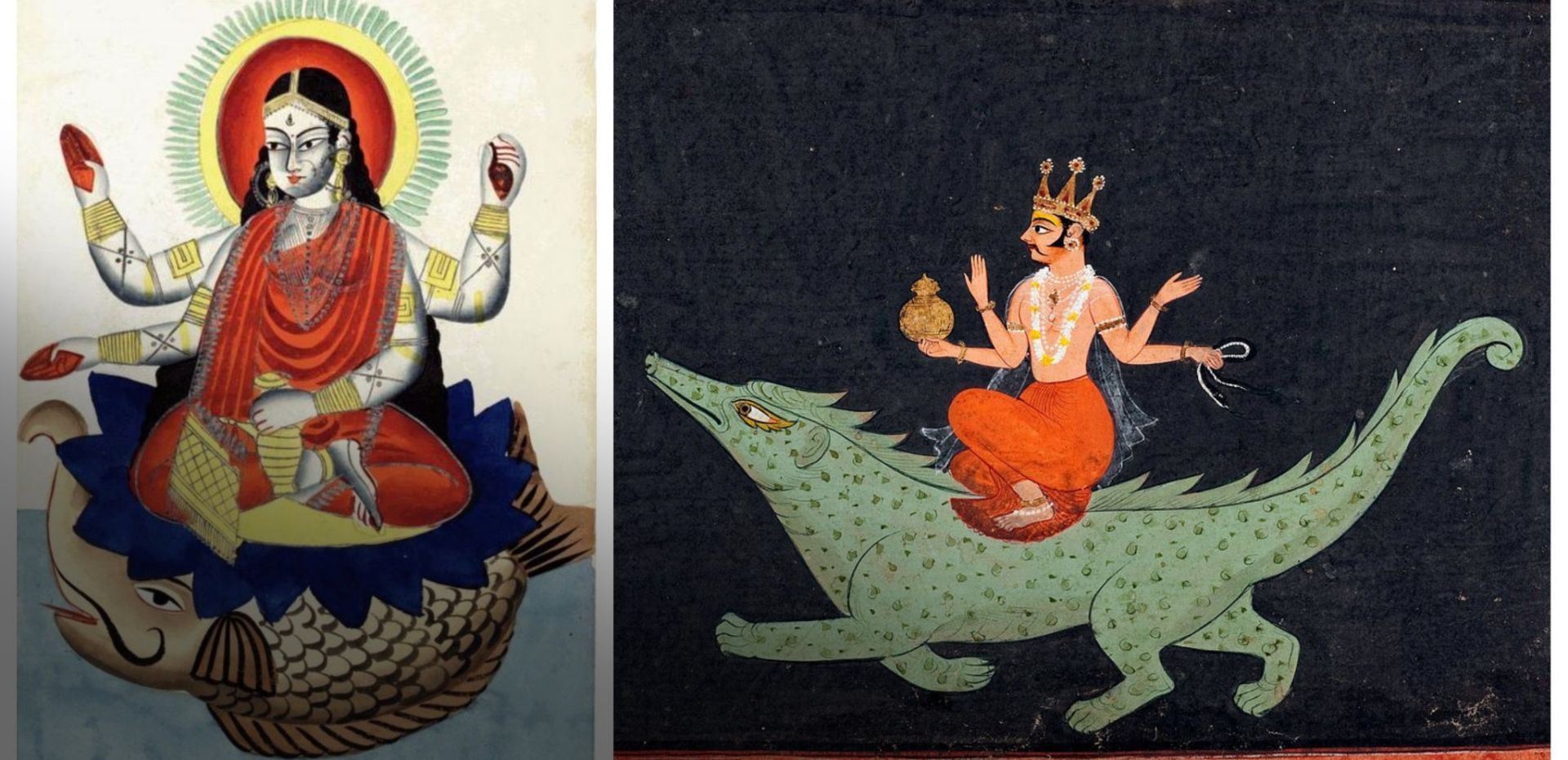
Makara is also associated with many gods. It is the vehicle of river deities Ganga and Varuna, and sometimes the emblem of Kamadeva. The crocodile is also the symbol of the ninth Jain Tirthankara, Suvidhinatha.
While sculptures of makara can be found on temples across India, the earliest representation of the crocodile is probably its image on the seals of Mohenjodaro depicted with a fish in its mouth.

Today, with crocodiles being worshipped in parts of Bengal and Goa as a protector of children and crops respectively, it wouldn’t be wrong to say that they are also the ultimate survivors. Having evolved around 200 million years ago, they have outlived the dinosaurs and will probably outlive humans too!
Cover Image: Makara as the vehicle of Ganga and Varuna
Join us on our journey through India & its history, on Peepul Tree's YouTube Channel. Please Subscribe Here

Your source for unique home decor and furnishings that blend modern design with traditional Indian craftsmanship. Responsibly sourced from over 11,000 artisans, our products reflect authenticity, sustainability, and fine craftsmanship. Discover the beauty of India with Peepul Tree.


