

From Sand to Thread: The Nomadic Journey of Craft
The Thar Desert, often dismissed as barren, has for centuries been the cradle of some of the most exquisite crafts in the world. This is not a landscape of emptiness—it is a vast, living museum of art, culture, and migration.
Here, between Sindh, Kutch, and Rajasthan, nomadic traders, herders, and artisans once moved freely, carrying not just their livestock but their traditions, techniques, and artistic expressions. Over generations, this network of movement led to the evolution of craft forms that are today synonymous with the region—Ajrakh block printing, Lippan mirror work, and Appliqué textiles.
But how did a desert, a land of shifting sands and scorching heat, become the birthplace of such artistic brilliance? The answer lies in pastoralism, migration, and cultural fusion—a centuries-old exchange that turned necessity into art.

The Thar Desert: A Crossroad of Cultures
The Thar Desert, stretching across Sindh, Kutch, and Rajasthan, has never been a barrier; it has always been a bridge. For centuries, pastoralist communities—the Rabaris, Maldharis, and Meghwals—navigated this terrain, moving between grazing lands, oases, and trade hubs. Their livelihoods depended on constant movement, and with them traveled ideas, skills, and aesthetics.
In these arid landscapes, self-sufficiency was key, and craft became an essential part of life. As these pastoralists moved through the desert’s ever-shifting dunes, their art evolved with them—expressed through textiles, mirror work, and embroidery that reflected their lives, beliefs, and landscapes. Among these, few crafts capture the essence of the nomadic spirit like Ajrakh, Lippan Kaam, and Appliqué.

Ajrakh: The Indigo Signature of the Desert
One of the earliest known textile traditions of the Indian subcontinent, Ajrakh block printing traces its origins back over 4,000 years to the Harappan Civilization. The image of the Priest-King of Mohenjo-Daro, wrapped in a shawl with trefoil motifs, is strikingly similar to the Ajrakh prints worn by Kutch’s Maldhari herders today.

Ajrakh printing was originally practiced in Sindh, but when Khatri artisans migrated to Kutch 400 years ago, they carried this knowledge with them. The craft was shaped by its new landscape—the deep indigo blue mirrored the vast sky over the desert, while the rich red hues reflected the earth. Using a complex 14-step resist-dyeing process, artisans created textiles that were not only aesthetic but functional—Ajrakh was designed to cool the body in the desert heat.
Despite earthquakes, migration, and modernization, Ajrakh remains a thriving craft today, with workshops in Ajrakhpur and Barmer continuing this ancient tradition. Its patterns may have evolved, but its essence remains unchanged—a timeless link between Sindh, Kutch, and Rajasthan.

Lippan Kaam: Mirrors That Capture the Desert Sun
If Ajrakh brought color to clothing, Lippan Kaam brought shimmer to the walls of homes. The nomadic communities of the desert not only wrapped themselves in intricate designs but also transformed their living spaces into canvases of art.
Lippan Kaam, also known as Chhittar Kaam, was originally developed by Rabari, Mutwa, and Kumbhar communities as both an art form and an insulation technique. The mirrors embedded in the walls reflected light, keeping interiors cool in the day and illuminated at night. The motifs—peacocks, camels, mango trees, celestial symbols—drew inspiration from everyday life, each pattern a reflection of the nomadic spirit.
Though traditionally restricted to walls and grain silos, Lippan Kaam has evolved into portable artwork, finding its way into urban homes, hotels, and museums. The mirrors that once shimmered only in desert settlements now glow under contemporary spotlights.

Appliqué: Patchwork Narratives in Fabric
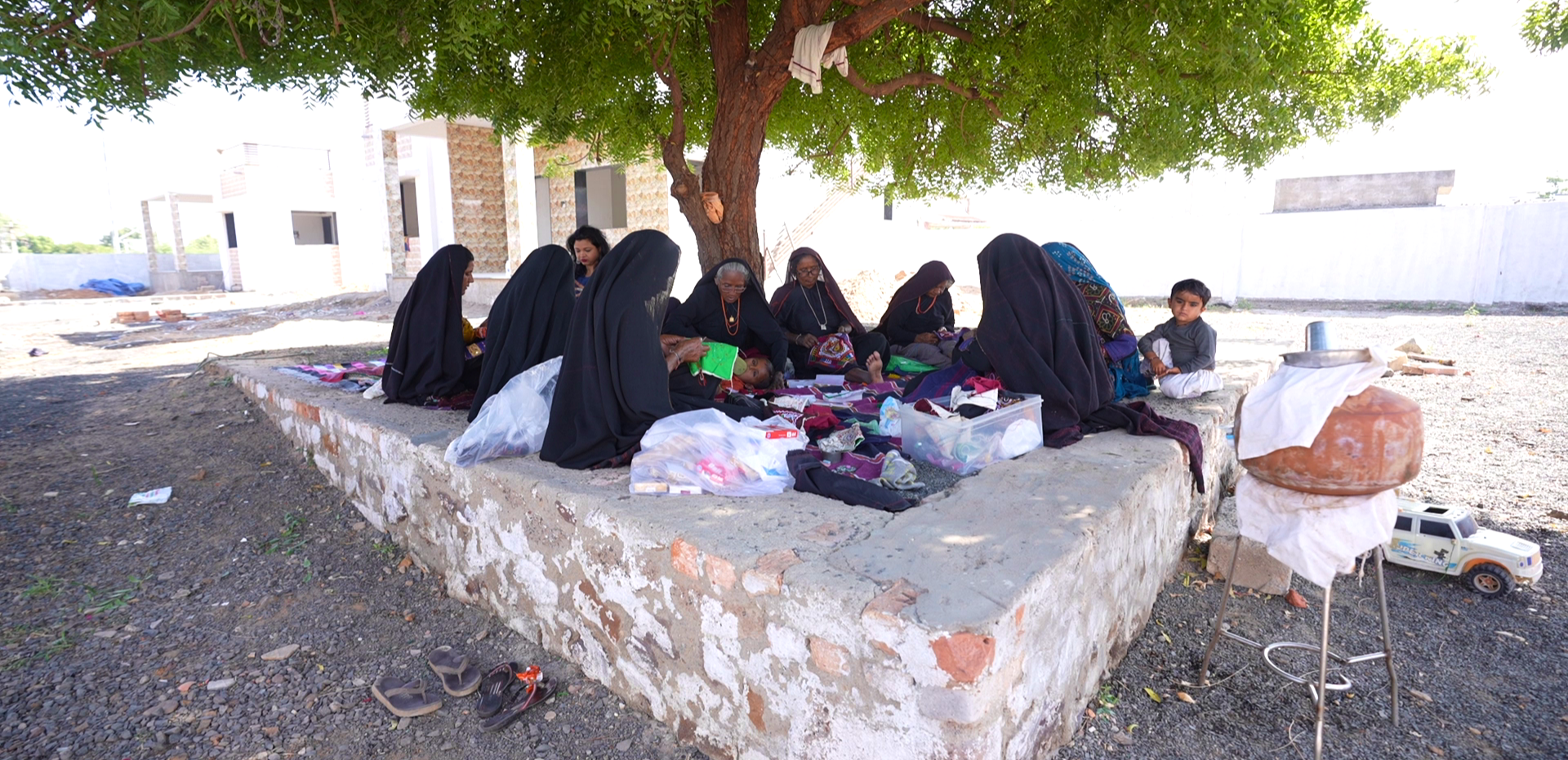
A young Rabari bride sits stitching her wedding dowry, piece by piece, onto a backdrop of black cloth. Her hands move rhythmically, weaving together not just fabric, but generations of memory. This is Appliqué—an art form born out of the need to repurpose fabric scraps, now transformed into exquisite patterns that tell the stories of nomadic life.
Originally, appliqué was a way to repurpose old fabric, creating functional tents, camel coverings, and dowry textiles. Over time, it evolved into an art form, with bold geometric patterns, floral motifs, and sacred symbols stitched into ceremonial pieces. Under Mughal influence, appliqué became more intricate, with artisans in Barmer crafting elaborate textiles for royal courts.
Even today, appliqué continues to be hand-stitched by women in Kutch, carrying forward the region’s heritage through every stitch and seam.
A Continuing Legacy
For centuries, these crafts thrived in self-sustaining ecosystems, where skills were passed down from generation to generation. But with the advent of mass production, mechanization, and shifting economies, many of these traditions faced decline. The 2001 Gujarat earthquake devastated craft villages in Kutch, threatening to erase centuries of artistic heritage. Yet, from the rubble emerged a new movement—one focused on revival, reinvention, and global recognition. Today, Ajrakh, Lippan Kaam, and Appliqué are finding pride of place in homes across India and internationally. Peepul Tree works with Applique , Lippan and Ajrakh makers across Barmer and Kutch to bring you a slice of this timeless trail.
The story of Sindh, Kutch, and Rajasthan is not one of separation, but of connection. The Thar Desert, rather than isolating cultures, became a canvas for exchange, where ideas, techniques, and aesthetics blended over centuries.

Your source for unique home decor and furnishings that blend modern design with traditional Indian craftsmanship. Responsibly sourced from over 11,000 artisans, our products reflect authenticity, sustainability, and fine craftsmanship. Discover the beauty of India with Peepul Tree.


